Dwarka Sector 22 has no published shifting rules: our October 2026 search found none for any of its 26 cooperative societies or for its DDA pocket. What is written down sits in Delhi's cooperative society rules, in DDA's records and in dated traffic orders, so moving hours, lift bookings and any deposit have to be asked of the committee or the neighbours who run your block.
The gate routine, basement parking and the drive to Gurgaon are explained on the packers and movers in Dwarka Sector 22 page. The nearest of our offices is the Dwarka branch, Shop No. 204 in Kartar Nagar, Sector 12. This guide stays with the rules: who makes them, what the published texts say, and what you will have to ask.
Who sets the rules at your Sector 22 address?
That depends on whether you live on a society plot or in the DDA pocket.
| Your home | What the record shows | Who sets the rules | Record and its date | Published moving rules, Oct 2026 |
|---|---|---|---|---|
| Cooperative society on a numbered plot | Jay Pee CGHS, Plot 2: registration No. 654 of 22 September 1983, 256 flats in eight categories | The society's managing committee, under its general body's regulations | RCS Rule 90 committee minutes, meeting of 19 July 2013 | Nothing published |
| DDA SFS flats, Pocket 1 (categories II and III) | Listed by Dwarka Homes | Unclear; no RWA for this pocket on DDA's register | DDA's registered RWA list, 15 February 2022 | Nothing published |
Check the plot letter as well as the number. The Dwarka Homes list for Sector 22 splits Plot 5 into four societies, 5A to 5D, and Plot 15 into three, 15A to 15C, with a Plot 6A beside Plot 6. Each is a separate cooperative with its own office and committee, so a rule you hear about from a friend two gates away may not apply to you.
The Jay Pee record also shows why charges can differ inside one complex: its flats come in eight categories, from A-1 to F. Where flat sizes differ like this, Rule 102(2) asks the society's regulations to spell out how the charges are fixed, so ask for that page too.
What do Delhi's cooperative rules say about the parts a move uses?
The Delhi Co-operative Societies Rules, 2007, which we read on the Registrar's website on 22 October 2026, never mention moving day. They do define the spaces a move passes through and say who runs them.
- Common areas (Rule 89). The explanation to Rule 89 lists stairs, lobbies, corridors, entrances and exits, basements, parking areas and elevators among a building's "common areas and facilities". Under Rule 89(7), the cost of keeping them up is shared among everyone with occupancy rights.
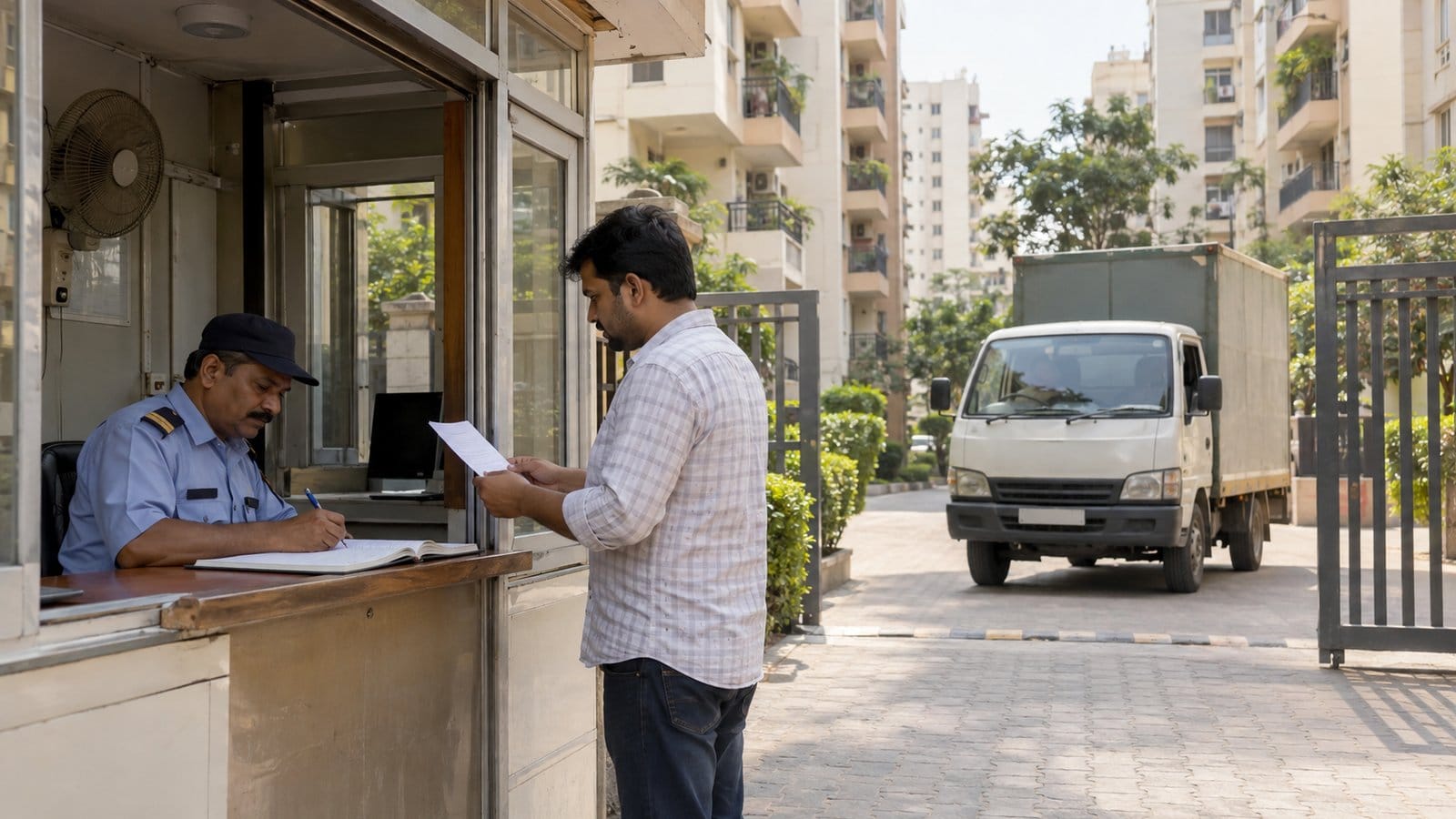
- Essential services (Rule 102(1)). The committee must keep the lifts running, provide security services and arrange round-the-clock emergency response. The guard who checks your truck and the lift that carries your cartons are both the committee's responsibility.
- Regulations (Rule 102(2)). The general body frames the regulations for these services and the basis of the charges. The same sub-rule says lift charges are payable by every member and resident, whatever floor they live on.
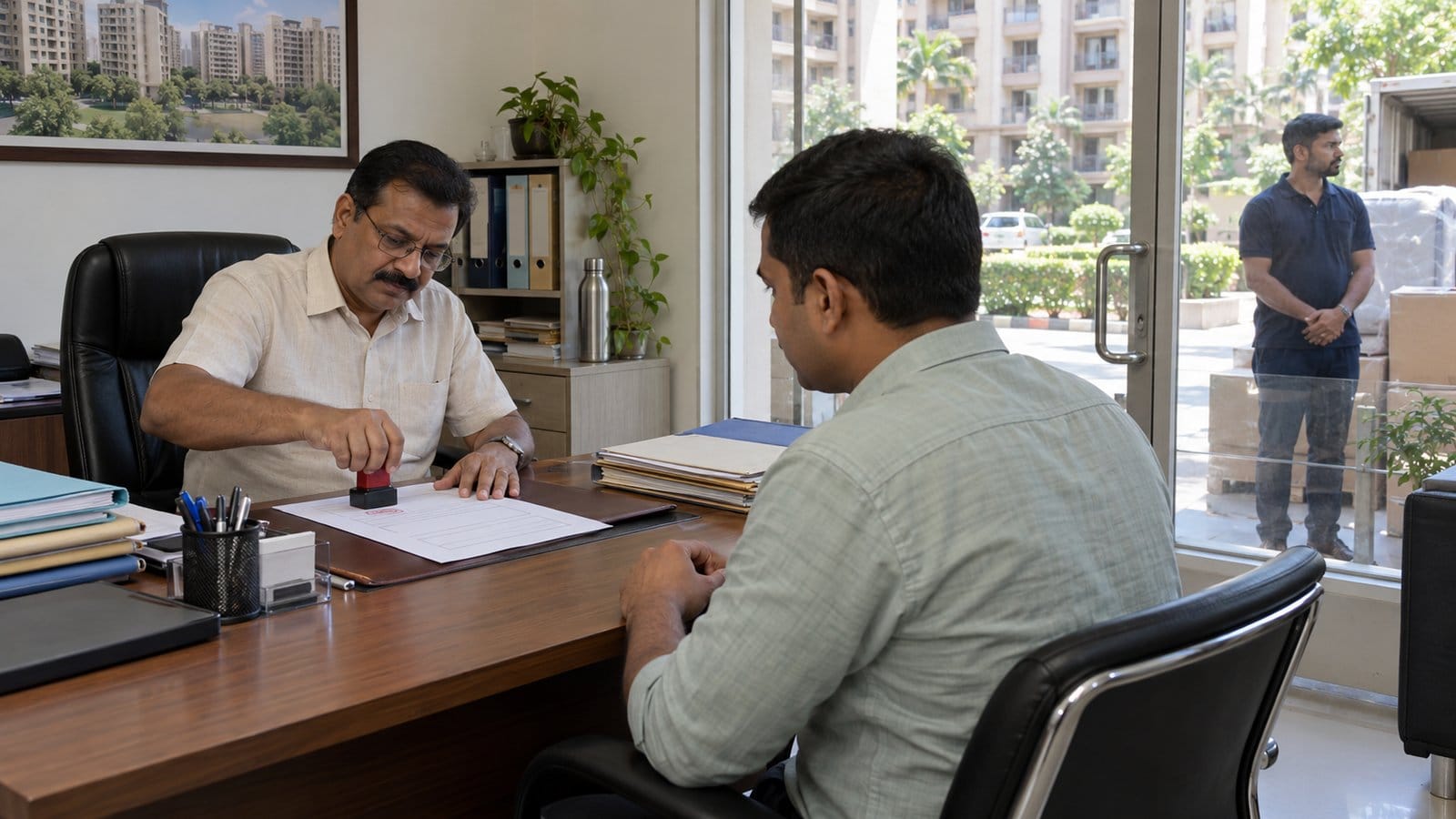
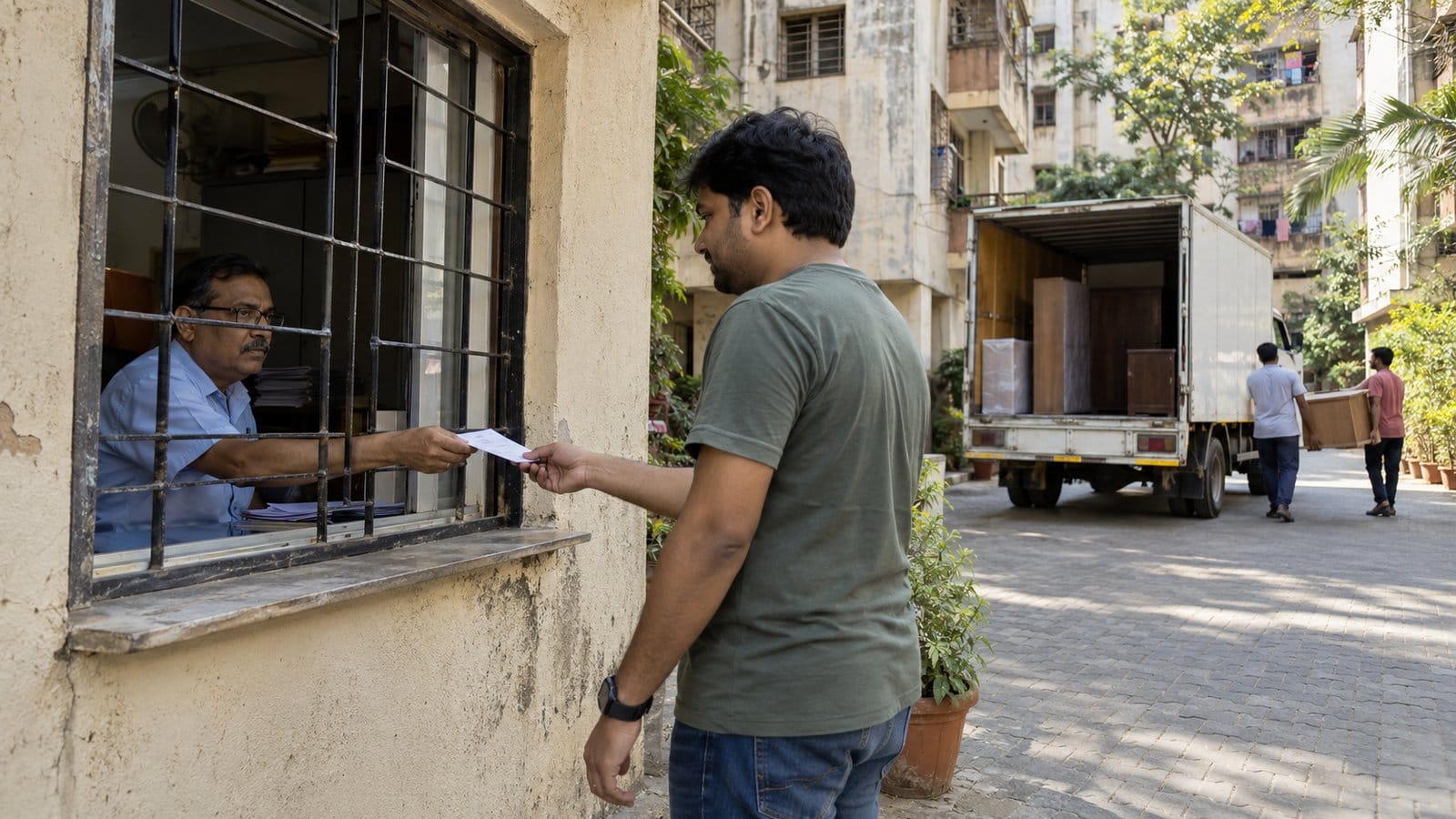
So if your society has set moving hours, a lift-booking routine or a moving charge, it should be written in those regulations or in a committee decision made under them. Ask to see the text, not just a notice on the gate.
Who pays if something is damaged during the move?
The rules allow for it, but they do not set a figure. Rule 106(6) says repairs outside the committee's own maintenance list, along with any item the general body approves or the bye-laws cover, are carried out by the committee at the cost of the member or occupant. In plain terms, if your bye-laws or a general body decision cover damage to a lift car or a lobby wall, the society can recover the repair cost from you.
No rule fixes a refundable moving deposit, its amount or the time within which it comes back. If your office asks for one, get three things in writing: the amount, the decision that allows it, and how and when it will be returned. A photograph of the lift car and lobby walls before the first carton goes in, and another after the last one, settles most arguments.
Can a society ask for a separate moving fee?
The rules do not name one. Regular charges reach residents in a set way: under Rule 102(4), the committee issues a schedule of demand approved by the general body, displays it on the notice board, and allows at least 15 days for payment, with simple interest of up to 15% a year on late payments.
A one-off charge that appears only when the truck arrives does not fit that pattern, so ask which resolution sets it and ask for a receipt. The Registrar's website also carries an older directive telling group housing societies not to charge an "entry fee" before handing over possession or issuing an NOC. It was issued under the 1973 rules, which the 2007 rules later replaced, so check with the Registrar's office how it applies today before you rely on it.
For renters, the society will also want your tenancy papers on file; our Sector 22 service page explains that step, so we do not repeat it here.
Which road and truck timings apply around Sector 22?
Unlike society rules, these orders are in print with dates, and they bind the truck whichever gate it uses.
| Order | What it says | Source and date | Check before the move |
|---|---|---|---|
| Market roads, Sector 10 | All goods vehicles barred 12:30 pm to 8 pm on the roads around Main Market Sector 10, Dwarka | Transport Department notification of 3 August 2021, amended 12 August 2022 | Whether your route or other address is near that market |
| Najafgarh Road | Heavy, medium and light goods vehicles (not three-wheelers) barred in two windows, 7–11 am and 5–11 pm, between Vikas Puri and the Kakrola police picket | Same notification | Whether the truck uses this road |
| Electric vans | Electric light goods vehicles (L5N and N1) keep their exemption on the identified roads | Same, 12 August 2022 amendment | The vehicle's category on its papers |
| No Entry Permission | A truck driving in the restricted hours must carry one; apply online for a year or three months, or for up to seven days by letter to DCP Traffic (HQ), Todapur | Delhi Traffic Police FAQ, read 22 October 2026 | Whether the truck holds one |
| BS-IV transition and GRAP | BS-IV goods vehicles registered outside Delhi lose their transition allowance once 31 October 2026 passes; the revised GRAP restricts outside diesel BS-IV light and medium goods vehicles at Stage III | WION, 30 September 2026 | The emission norm, and the GRAP stage on your date |
| Winter curb | Commercial vehicles from other states that fall short of BS-VI are kept out between 1 November 2026 and 31 January 2027; CNG and electric ones are exempt | The Hindu, 28 September 2026 | Any later change to the plan |
Many Sector 22 moves are to or from Gurgaon, which usually means a truck with Haryana plates, so the winter curb decides which vehicle can come at all. If the truck has to wait outside your gate, park it where the guard allows: the same FAQ puts towing at Rs 1,000 for a light goods vehicle, with Rs 1,000 a day in custody after 48 hours, and Rs 1,500 for medium and heavy ones. For routes and timings across the border, see moving between Delhi and Gurgaon; the permit itself is explained in our house shifting in Delhi guide.
What should you ask where nothing is published?
Send these to your society office, or to the neighbours who handle the pocket's common areas, and keep the replies:
- To do: Which society runs my plot letter and block, and who signs the gate pass?
- To do: Which days and times does the society allow for loading and unloading, and where is that written?
- To do: Can the lift be reserved for loading, and can it carry a fridge standing up?
- To do: Is a deposit or moving charge taken? Which decision sets it, and when is a deposit refunded?
- To do: Where may the truck stand, given that the basement ramp is off limits for most trucks?
- To do: Do you need my agreement or sale deed before the goods come in?
- To do: Are my maintenance charges clear on the current schedule of demand?
- To do: Who removes empty cartons and packing waste afterwards?
If you are moving between two Sector 22 plots, put the same questions to both offices and pick a day that suits each of them.
Key takeaway
In Dwarka Sector 22, each plot's managing committee sets the shifting rules and none publishes them, while the DDA pocket has no registered RWA on DDA's 2022 list. Rules 89, 102 and 106 cover the common areas, lifts, charges and repairs a move touches; the truck windows and winter orders are dated. Ask for the rest in writing.
What else should you read?
Two neighbouring rules guides take different angles: Dwarka Sector 10 on the membership transfer timeline for buyers, and Dwarka Sector 7 on charges for tenants. For what the crew does on moving day, see household shifting. Once your office has replied, send us the answers with your floor and preferred dates.
This page is general information, not legal advice. Society regulations, DDA records, traffic notifications and pollution orders can change without much notice, so check the present position with your managing committee, DDA, Delhi Traffic Police or the Registrar of Cooperative Societies before you rely on it.
Sources
- List of societies in Sector 22, Dwarka
- List of societies in DDA Flats Sector 22, Dwarka
- Minutes of the Rule 90 committee, Jay Pee CGHS (Regn. No. 654), Plot No. 2, Sector 22, Dwarka
- Registered RWA List
- The Delhi Co-operative Societies Rules, 2007 (updated file)
- Entry fee not to be charged by Housing Societies (directive under Rule 77, Delhi Co-operative Societies Rules, 1973)
- Notification No. F.19(183)/Tpt./Sectt./2017/70257 (3 August 2021) and amendment No. 74376 (12 August 2022): restrictions on goods vehicles on specified roads
- Frequently Asked Questions (No Entry Permission; towing charges)
- Delhi tightens pollution rules ahead of winter, BS-IV and older goods vehicles face fresh curbs
- Delhi announces vehicle curbs, work from home, construction bans for winter pollution