Moving in Sector 37D in the monsoon is mostly a question of water on the approach roads: the tehsil gauges at Harsaru and at Kadipur, the tehsil HRERA gives for Ramprastha City, recorded some of the district's heaviest rain in July and August 2026, and 37D drains into the Badshahpur drain, whose relief works are still new. This post goes live on 6 November 2026, about six weeks after IMD declared the season over in Delhi, so a move this month is limited by GRAP Stage II and Delhi's winter entry rule; the rain and heat sections are there to help you choose a date in 2027.
Each figure below comes from a dated record listed at the end. Our page on the service, packers and movers in Sector 37D Gurgaon, covers crews and booking; for passes and who controls each society gate, see the Sector 37D rules guide.
What limits a Sector 37D move in November 2026?
Smog-season orders, not weather. Three dated items apply this week:
| Date | What changed | Source | Effect on moving day |
|---|---|---|---|
| 21 Oct 2026 | Stage I of GRAP comes into force in all of the NCR | Business Today | Household goods vehicles keep running |
| 1 Nov 2026 to 31 Jan 2027 | Delhi bars outside-registered vehicles below BS-VI | UNI | A truck bound for Dwarka or any Delhi address must be BS-VI |
| 2 Nov 2026 | Stage II invoked NCR-wide after Delhi's AQI climbed from 117 on 31 October to 324 | National Herald | More roadside checks of pollution certificates; no stop on moving trucks |
Stage II adds mechanical sweeping, water sprinkling, police at congested junctions and spot checks of PUC certificates. For a mover, that last point is the practical one: ask that the vehicle's pollution certificate is current, because a stop at a checkpoint costs lift time at the other end.
The generator question is the one to put to your facility office. Business Today reported in October that the revised GRAP schedule moves some diesel generator measures into Stage I, and Stage II now runs alongside it. In a tall tower such as BPTP's Terra, where our newcomer guide notes 23 storeys, ask whether the backup may legally run the service lift during a cut under the stages now in force. By 5 November we had found no order for Stage III.
When will next year's monsoon arrive and leave?
Plan for late June to early October, which is wider than the textbook dates. IMD's New Delhi centre treats a 27 June arrival and a 25 September exit as Delhi's normals, and its 23 September 2026 release adds a table of every year since 2001. The last ten years look like this:
| Year | Onset over Delhi | Withdrawal | Days of monsoon |
|---|---|---|---|
| 2017 | 2 July | 30 September | 90 |
| 2018 | 28 June | 1 October | 95 |
| 2019 | 5 July | 10 October | 97 |
| 2020 | 25 June | 25 September | 92 |
| 2021 | 13 July | 8 October | 87 |
| 2022 | 30 June | 29 September | 91 |
| 2023 | 25 June | 30 September | 97 |
| 2024 | 28 June | 2 October | 96 |
| 2025 | 29 June | 24 September | 87 |
| 2026 | 2 July | 23 September | 83 |
For a 2027 booking, note two things. Withdrawal came later than the 25 September normal in seven of the ten years, as late as 10 October in 2019. And 2026, at 83 days, was the shortest season of the decade, so do not take this year's early finish as the pattern. The same release puts Safdarjung's rain from 1 June to 23 September 2026 at 728.6 mm, 16% above normal. Safdarjung is a Delhi station, so read it as a regional guide.
How hard did it rain on the Sector 37D side in 2026?
Hard enough to plan around, on three dated occasions. The tehsil gauges at Kadipur and Harsaru are the most local official readings in the reports; HRERA records Ramprastha City under Kadipur, as our area page notes.
| Date | What was recorded | Source |
|---|---|---|
| 7 July | 82 mm at Kadipur and Harsaru, the highest tehsil reading; Basai and Pataudi Road among the waterlogged stretches | The Tribune |
| 6 August | 74 mm each at Kadipur and Harsaru in the 24 hours to 8 am; 97 mm in Gurugram; work-from-home advice for 6 and 7 August | Dynamite News |
| 4 September | 36 mm in an hour; the expressway tunnel slowed by standing water | Business Today |
The September item matters because the tunnel is at the Delhi end of the expressway. Even a move that stays on the expressway the whole way, avoiding every railway gate, can meet slow water in a cloudburst. On the August day the district administration urged firms to allow remote work so that traffic stayed off flooded roads, and Dynamite News reported early-morning power cuts in residential areas. A move booked for a day like that should simply wait.
Where does Sector 37D's rainwater go?
Into the Badshahpur drain, the city's largest storm channel. In a Tribune report from late June 2026, GMDA said it had desilted all three master drains before the monsoon. It described Leg 3, the 26 km Badshahpur drain, which can carry 3,800 cusecs, as taking water from Gadoli, Sector 37D, Dhankot and Pataudi Road to the Najafgarh drain near Sector 99.
Two newer works feed the same system:
- Leg 4. A 4.6 km box drain runs from Vatika Chowk on the Southern Peripheral Road to Ramprastha Society near the Dwarka Expressway, where it joins Leg 3 just short of the railway line. It was built to take load off NH-48 and serves Sectors 68 to 80.
- The 37D network. A drain from the NPR–SPR cloverleaf through 37D to the Najafgarh drain was due by 15 May 2026 under a GMDA deadline, The Tribune reported. Separately, a property portal, 100acress, wrote on 28 May 2026 of a Rs 30 crore GMDA project for about 5.5 km of drains inside 37C and 37D, blaming waterlogging on an overflowing pond nearby. We found no GMDA notice confirming that project's start or finish.
What this means for a booking: the main channel is old and large, the branches into it are new or still planned, and Leg 4 now meets Leg 3 close to the sector. Ask your society office what happened at its gate on 7 July and 6 August 2026; that answer is a better guide to your block than any city-wide claim.
Which way should the truck come in on a wet day?
The one that is clear that morning. The sector has two kinds of approach. The expressway reaches it over a road bridge across the Delhi–Rewari line, so it never waits for a train, but it carried slow water through its tunnel on 4 September. The shorter roads towards old Gurugram can meet a level crossing, and Basai and Pataudi Road were both waterlogged on 7 July.
A wet-day plan therefore needs three checks:
- The night before. Look for an IMD orange or red warning for Gurugram. If one is out, move the slot.
- The morning itself. Ask the guard at your gate whether the internal road and the approach are clear.
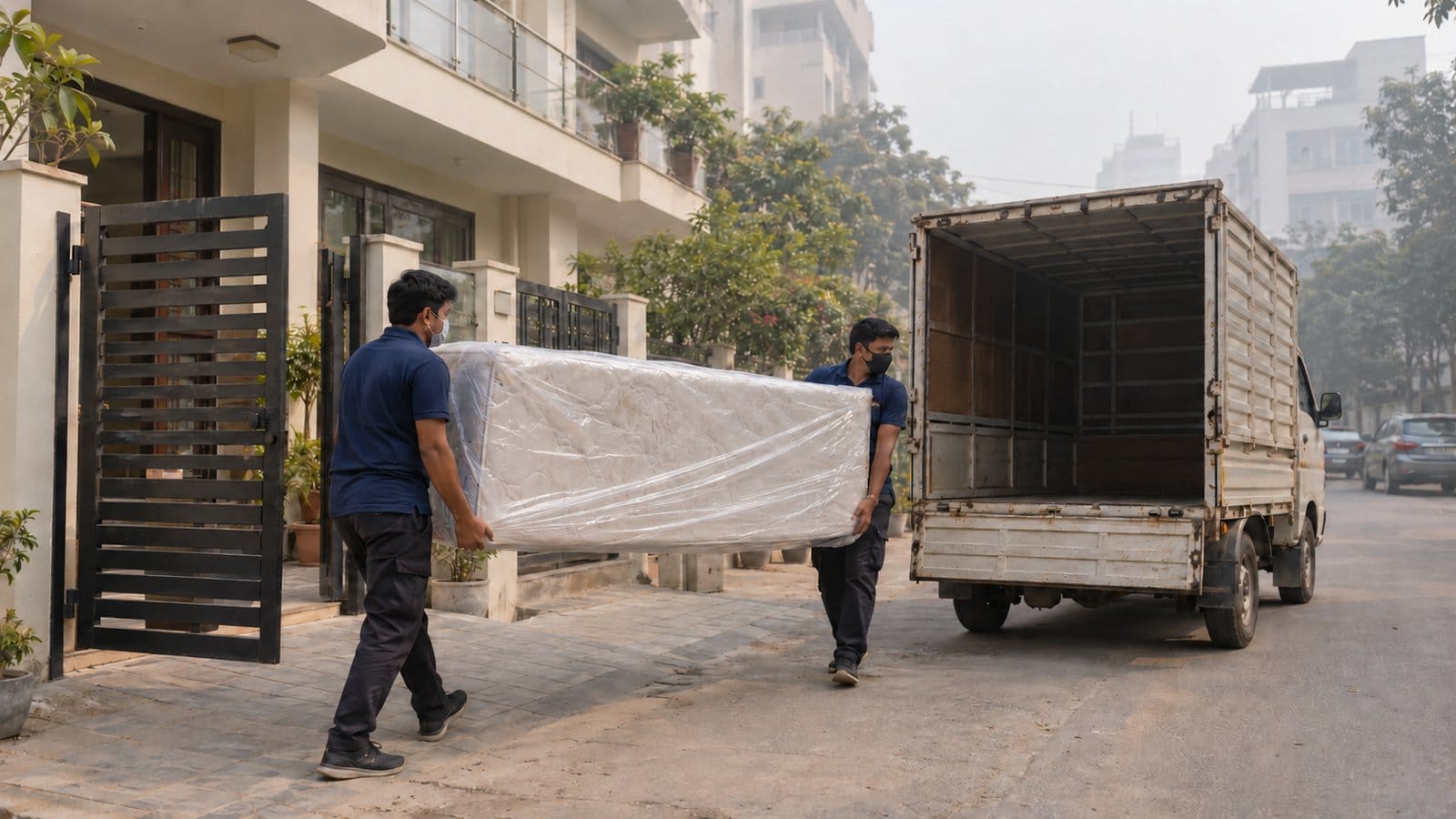
- On the way. If water is standing across the road, the truck waits or turns back. No one drives a loaded vehicle or carries furniture through floodwater.
How hot does a moving day get in May and June?
Hot enough to change the order of work. Amar Ujala put Gurugram at 44.5°C on 20 May 2026, with a night low of 28°C. Two days later the paper reported that the orange heat-wave alert, first set to end on 24 May, had been stretched to 26 May, with 41.4°C recorded on 22 May.
The sector's two kinds of home react differently:
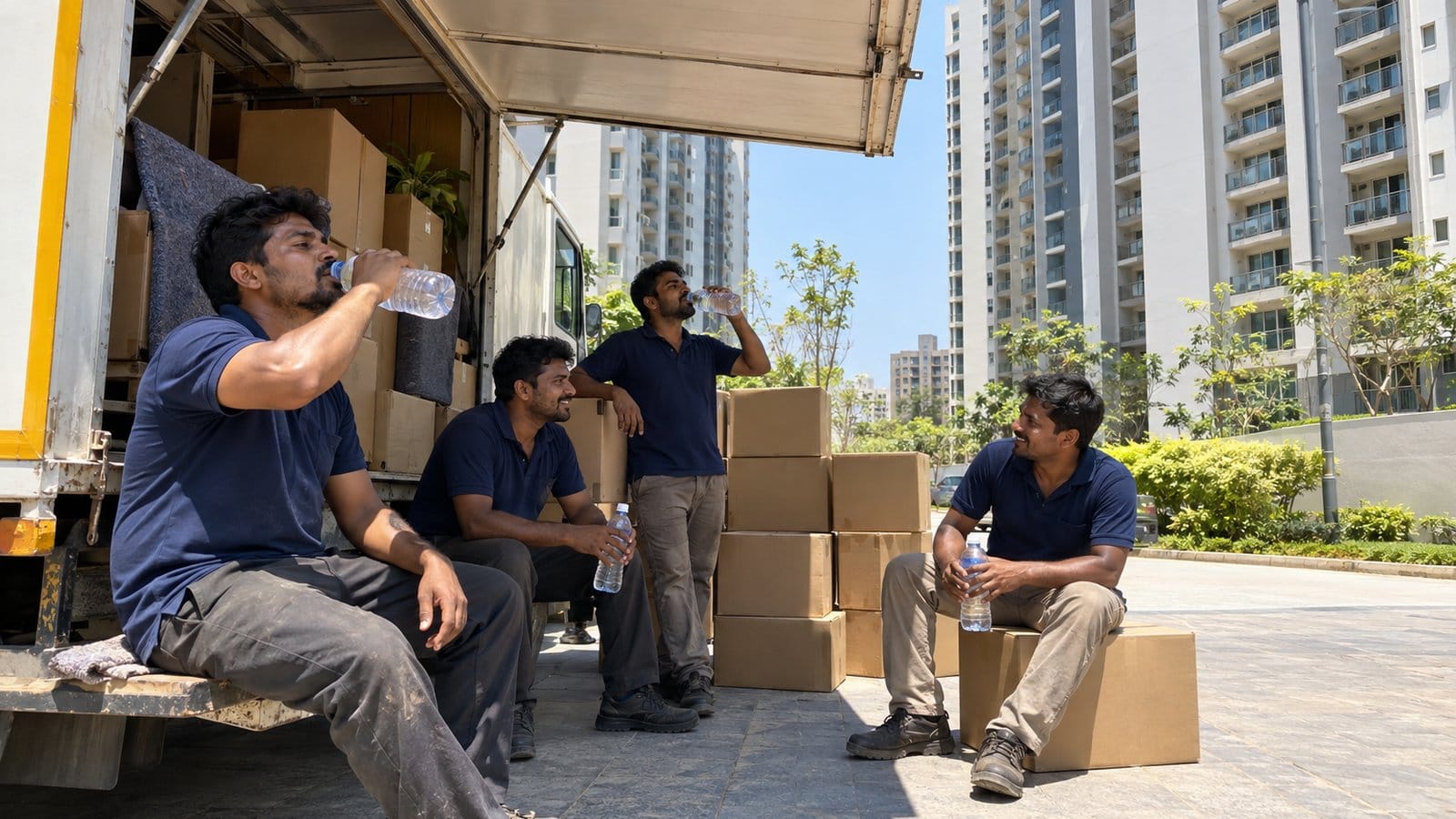
- Towers. The service lift sets the pace. Book the first slot of the day, send beds, wardrobes and appliances down first, and keep the afternoon for packing indoors.
- Plotted floors. In Signature Global's four-home buildings, big pieces may go by the stairs. Carry them early, while the stairwell is cool, and pause rather than push in the afternoon.
Keep medicines, laptops, candles and plants out of a May or June truck, and carry water for everyone working at both ends.
Which months suit a Sector 37D move?
| Months | What the 2026 record shows | Plan |
|---|---|---|
| November to January | Stage II from 2 November; Delhi's BS-VI entry rule until 31 January | Check the GRAP stage and the generator; BS-VI truck for Delhi |
| February to April | No dated weather risk found for 37D | Standard planning; morning loading from April |
| May to mid-June | 20 May 2026 hit 44.5°C; heat alert to 26 May | Heavy work finished by late morning |
| Late June to early October | 82 mm on 7 July; 74 mm on 6 August; tunnel slowed on 4 September | Reserve date, both routes checked, covered loading |
| October | Rains gone by 23 September in 2026, but as late as 10 October in 2019 | Keep a spare date for the first week |
This is a record of past seasons, not a forecast.
What goes on a Sector 37D weather checklist?
- To do: Give us the project, the tower or plot, the floor and the truck gate.
- To do: Check with the facility office that the generator may power the service lift under the current GRAP stage.
- To do: For any Delhi destination before 1 February 2027, get BS-VI written on the quote.
- To do: From late June to early October, agree a reserve date in writing with both buildings.
- To do: Ask your society how its gate fared on 7 July and 6 August 2026.
- To do: For a May or June date, reserve each building's earliest lift booking.
- To do: Carry papers, jewellery, medicines and phone chargers in your own bag.
- To do: Lay sheets and mats in both lobbies on a wet day.
Should the road or the new flat not be ready, our warehouse can hold the load until it is. Crew time, lift sharing and plotted-floor access are covered in the Sector 37D costs guide, and the neighbouring sectors up the corridor in our Dwarka Expressway sector guide.
Will a wet or hot date cost more?
No; the bands hold in every month. Under the owner's indicative figures for October 2026, a one-bedroom 37D home going elsewhere in Gurgaon falls in a Rs 4,500 to Rs 7,000 band, a two-bedroom home in a Rs 8,000 to Rs 12,500 band and a three-bedroom home in a Rs 12,000 to Rs 15,000 band. With Delhi as the destination, the one-bedroom band rises to Rs 7,000–8,000, the two-bedroom band to Rs 10,000–13,500 and the three-bedroom band to Rs 14,000–16,500. Rain and heat cost time instead: a wait for a road, a later start at the second building, or storage, which is priced separately. Our Gurgaon charges guide explains where in a band a quote falls.
Key takeaway
In November 2026 a Sector 37D move is shaped by GRAP Stage II, generator rules for the service lift and Delhi's BS-VI entry rule to 31 January. For 2027, treat late June to early October as wet, since withdrawal ran past the normal date in seven of the last ten years, and expect water near Kadipur and Harsaru on heavy days. In May, finish heavy carrying by late morning.
Our nearest branch to the sector is in Sector 99A, Gopalpur, and the office takes calls from 8 am to 9 pm on every day but Sunday, when it is shut. When a date firms up, send us both addresses with the tower or plot at each end.
This is general information drawn from the records listed above, read on 5 November 2026. GRAP stages, drain works and Delhi's entry rules can shift within days; look again at IMD warnings, CAQM orders and your society's notices before fixing a date.
Sources
- Press release: withdrawal of Southwest Monsoon 2026 from Delhi (with onset and withdrawal table since 2001)
- First heavy monsoon rain triggers waterlogging, road cave-ins in Gurugram
- Gurugram rains: heavy showers bring India's corporate hub to a standstill, work-from-home advisory issued
- Haryana rains: waterlogging roils Dwarka Expressway tunnel; IMD issues yellow alert for 15 districts
- Gurugram Metropolitan Development Authority completes desilting of drains (The Tribune, via Newswav)
- Gurugram monsoon 2026: GMDA sets non-negotiable May 15 deadline for major drain projects
- GMDA's Rs 30 crore project to end waterlogging in 37C and 37D
- The sky is raining fire, people are sweating profusely (in Hindi)
- Orange heat-wave alert issued in the district till May 26 (in Hindi)
- Delhi air turns 'poor': GRAP-1 curbs kick in. What are allowed and what are not?
- Delhi-NCR chokes ahead of Diwali as AQI hits 334; GRAP-2 implemented
- Delhi to restrict entry of non BS-6 compliant vehicles registered outside city from Nov 1 to Jan 31
- Packers and movers in Gurgaon: indicative price ranges (October 2026)