In Dwarka Sector 12, the riskiest moving days of 2026 were the heat-wave days of late May and the end of June, and the first half of September, when Palam, the weather station nearest Dwarka, logged 84% more rain than its September normal. So plan a summer move around the day's forecast rather than the month, plan a monsoon move around the few junctions and drains where water gathers, and from November plan around Delhi's truck rules instead of the weather.
We know the sector well, because our Delhi branch is here, at Shop No. 204 in Kartar Nagar; how we handle its societies and DDA pockets, floor by floor, is described in packers and movers in Dwarka Sector 12. This post deals only with heat and rain: what the 2026 record shows, where Sector 12 gets wet, and what we change on the day.
What did the end of the 2026 monsoon bring at Palam?
Its heaviest rain. Palam, IMD's observatory at the airport, is the closest of Delhi's five manual weather stations to Dwarka, and in September 2026 it collected 201.2 mm, close to double its normal for the month and more than its July total of 182.1 mm. The September report, the July report and two news reports give the sequence:
| Date | What happened | Why it matters on a moving day |
|---|---|---|
| 2 September | 64.2 mm at Palam, just short of IMD's "heavy" mark | Wet roads and slow traffic out of Dwarka |
| 4 September, afternoon | Squall at Palam with gusts of 76 km/h, 7 mm of rain and visibility down to 600 m | Loading stops; loose covers blow off |
| 5 September | 84.0 mm at Palam, the only heavy-rain day in Delhi that month | Business Today reported water in the Dwarka Expressway tunnel |
| 6 September | The Pioneer reported the Dwarka underpass towards the airport under water | The airport-side route out of Dwarka is unreliable |
| 12 September | 35.6 mm at Palam | A second wet spell, a week later |
| 23 September | IMD declared the monsoon withdrawn from Delhi | The rain risk largely ends |
IMD counts each day's rain over the 24 hours that end at 8:30 am, so the figure for 5 September covers the period from 8:30 am on the 4th. The withdrawal release adds that the rains reached Delhi on 2 July, against a normal date of 27 June.
The lesson for a Sector 12 family is that the monsoon's last weeks can be among its worst. Many people book an early-September move expecting the rains to be winding down; in 2026, the first five days of the month brought Palam's two wettest days.
Why can the Delhi rain headlines be wrong for Sector 12?
Because they usually quote Safdarjung, in central Delhi, while Dwarka sits beside the Palam observatory at the airport. In September 2026 the two told opposite stories. The September report gives these totals for Delhi's five manual observatories:
| Observatory | Rain, September 2026 (mm) | Normal (mm) | Departure |
|---|---|---|---|
| Palam | 201.2 | 109.5 | +84% |
| Ridge | 83.6 | 119.1 | −30% |
| Lodhi Road | 80.3 | 123.5 | −35% |
| Safdarjung | 79.6 | 123.5 | −36% |
| Ayanagar | 54.6 | 109.3 | −50% |
A reader in Sector 12 who saw "September 36% below normal" would have planned for a dry month, and met two days of 64 mm and 84 mm instead. When you check the weather for a moving date, look for the Palam figure or a forecast for south-west Delhi, not the citywide headline.
Where does water gather in and around Sector 12?
Within the sector, two spots matter most for a truck.
The Sector 12 red light. In July 2025, Dwarka City singled out this junction as one where water keeps pooling after rain. After a heavy night we route the truck so that it does not have to wait at that signal with a full load.
Drain covers near KM Chowk. The Tribune reported that in February 2025 the slab over a drain near KM Chowk gave way and a car dropped into the pit. A loaded truck is far heavier than a car, so in wet weather, when a weak slab is hard to spot under water, our driver parks on solid road and the crew walks the last few metres.
Drain cleaning helps, but it is not a guarantee. On 10 July 2026, The Pioneer reported that the DDA had taken 57,000 tonnes of silt out of stormwater drains across six zones, Dwarka among them, 70% more than the year before. Two months later, on the heavy-rain days of early September, the main roads out still flooded: Business Today reported on 5 September that waterlogging had slowed traffic in the Dwarka Expressway tunnel, while The Pioneer reported the Dwarka underpass towards the airport under water on 6 September. Those two routes are described in more detail in our Sector 13 monsoon post, which covers the sector next door.
The station frontage. Wikipedia describes the Dwarka Sector 12 metro station as the busiest in Dwarka, with City Centre opposite. In a shower, commuters and autos crowd any shelter near the station, so we never plan a loading stop on that stretch.
How does the heat change a Sector 12 moving day?
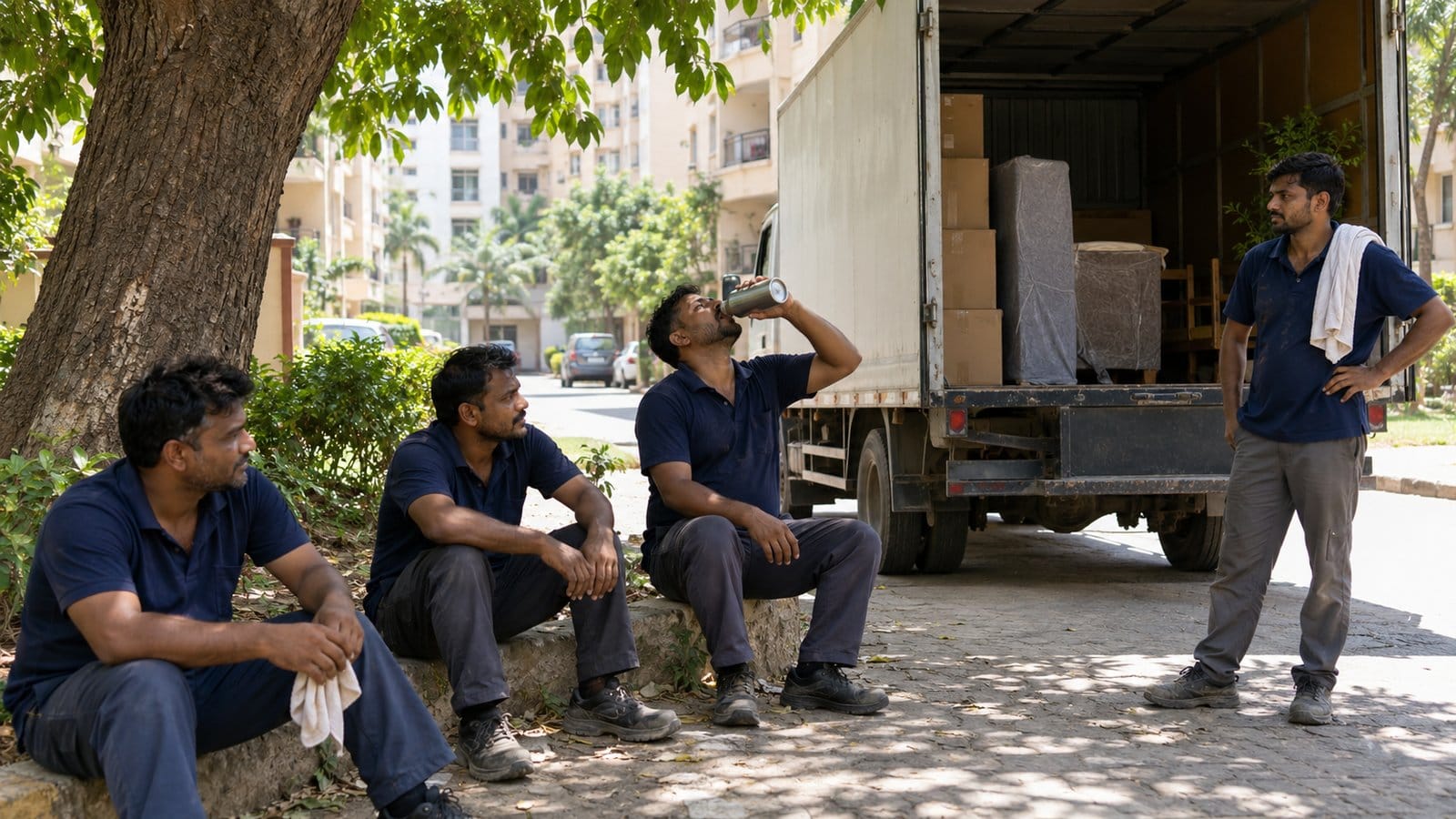
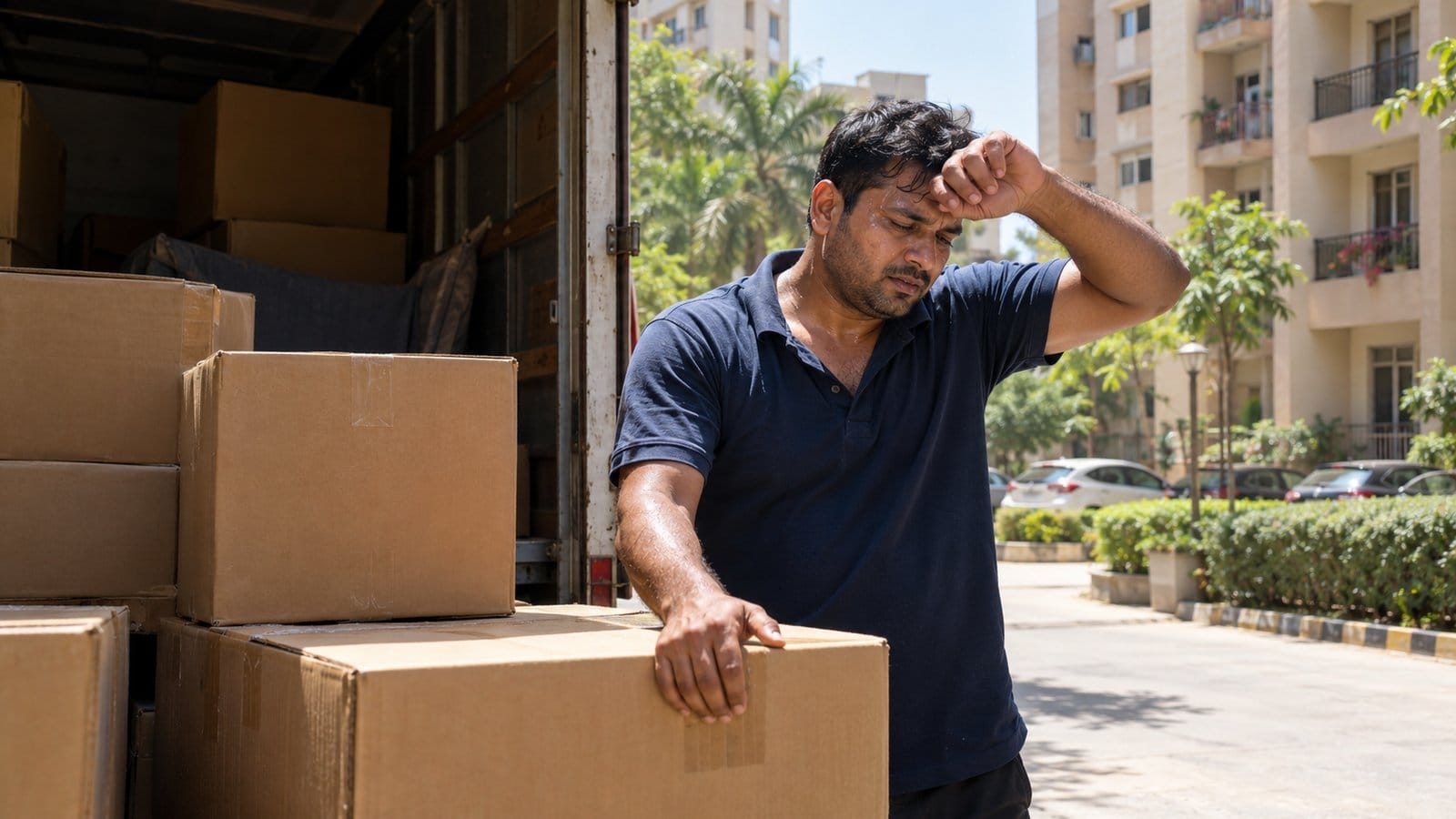
Heat came in short bursts in 2026. IMD's reports count six heat-wave days over Delhi between 18 and 27 May and two more at the end of June; our Sector 7 monsoon guide sets those dates out alongside the evening squalls of the same weeks. On any such day, the building decides how hard the move will be. Sector 12 has 27 cooperative society plots and eight DDA pockets, and the two kinds of home suffer in different ways on a hot day.
In a DDA block without a lift, the crew carries every piece down the stairs. In a heat-wave week that is the slowest and most tiring job we do, so we add hands, keep cartons light and plan a rest in the shade after each trip, rather than asking the same people to keep going. In a society tower the lift does the carrying, but the lift needs power. If the society has a backup supply, ask whether it runs the lift or only the corridor lights.
Water is the other summer question. In a Dwarka City report of 1 July 2025 on the sub-city's shortage, one Sector 12 mother said children were going without baths, and another Sector 12 resident alleged that water meant for Dwarka was being sent to other areas. On a moving day you need water twice: to clean the flat you are handing back, and for a crew working through the heat. Fill a few containers the night before and keep them out of the truck.
Warm nights matter too. IMD's May report records warm-night conditions over Delhi on 21 and 25 May 2026, and on the 25th the temperature at Safdarjung did not fall below 32.4 °C, the highest minimum of the month. Starting early still helps with traffic, but it is not a cure for the heat.
What do we change when the forecast turns?
We look at IMD's Delhi forecast and warnings the day before and again on the morning of the move. This is what each kind of warning changes:
| If the forecast says | What we do in Sector 12 |
|---|---|
| Heat wave | Larger crew for walk-up blocks, loading done before late morning, water and rest breaks planned |
| Warm night | No promise that an early start will be cool; same breaks as a hot afternoon |
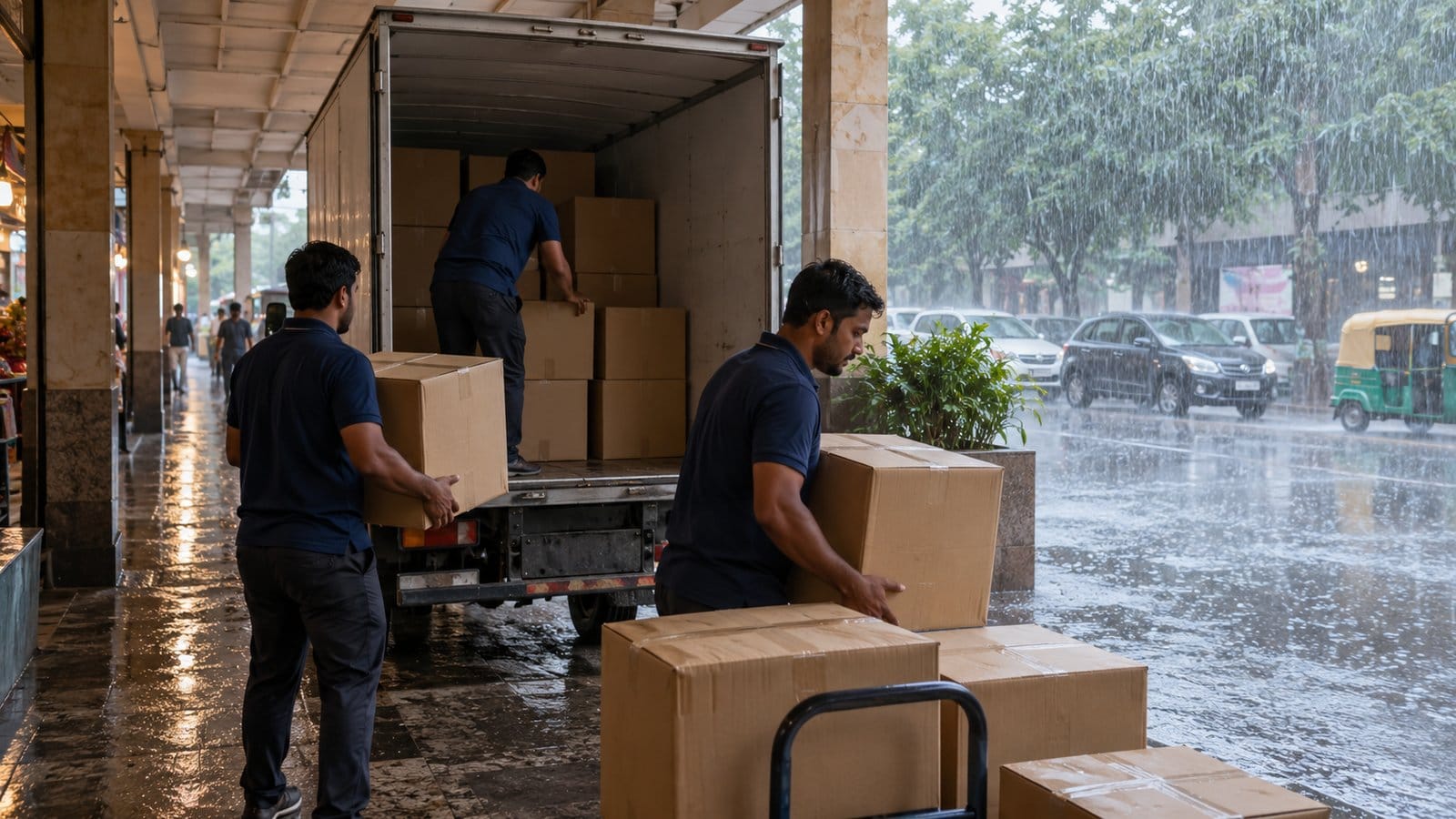
| Thunderstorm or squall | Upholstery wrapped before it leaves the flat; loading paused while the storm passes |
| Heavy rain overnight | Route checked past the red light and out to the expressway or underpass before the truck leaves |
| Red alert | We suggest moving to the reserve date |
- To do: Agree a reserve date when you book a move between May and September
- To do: Keep medicines, documents and laptops in your own car, not the truck
- To do: Ask the society office whether the lift has backup power
- To do: Store water the night before for cleaning and for the crew
If the new flat is not ready because of a leak or a delayed repair, your goods can wait in our storage for a few days.
What should you check after the monsoon?
Air quality and the truck's papers, now that the rain has gone. IMD declared the monsoon withdrawn from Delhi on 23 September 2026. On 21 October, Akashvani reported that CAQM had invoked Stage I of GRAP across the NCR after Delhi's AQI reached 244. When we searched on 24 October we found no higher stage in force, but stages can change within days (check on your date).
| Rule | What it says | Source |
|---|---|---|
| BS-IV trucks registered in other states | Entry permitted until 31 October 2026 as a stop-gap; no extension found when we searched on 24 October 2026 (check) | Transport department notice, reported by The Tribune, 27 October 2025 |
| GRAP Stage III | Under the revised schedule, this stage now covers BS-IV and older diesel goods vehicles in the light and medium classes from other states | WION, 30 September 2026 |
| Winter entry curb (November 2026 to January 2027) | Commercial vehicles from outside Delhi must be BS-VI to come in; CNG and electric vehicles are exempt | The Hindu, 28 September 2026 |
| No Entry Permission | Needed for a goods vehicle driving in Delhi's restricted hours | Delhi Traffic Police FAQ, read 24 October 2026 |
Our house shifting in Delhi guide explains the permit and the paperwork in more detail.
Does the season change the price?
No. We do not add a monsoon or summer surcharge. The owner's October 2026 bands for a home brought into Delhi from Gurgaon are: one bedroom, Rs 7,000 rising to Rs 8,000; a 2 BHK, Rs 10,000 rising to Rs 13,500; a 3 BHK, Rs 14,000 rising to Rs 16,500. They appear with the other destinations on our Delhi packers and movers page. Moves that start and end inside Delhi, such as Sector 12 to Janakpuri, are quoted only after a survey.
What weather can change is the time a job takes: a storm that halts loading, a lift that stops in a power cut, or a long way round a flooded underpass. Ask for the quote to say how such delays are treated.
Key takeaway
For a Sector 12 move, watch the day's forecast rather than the month: 2026 brought heat in short runs in May and June and its heaviest Dwarka rain in early September, when Palam was far wetter than the citywide figure. Keep the truck clear of the red-light junction and drain slabs after rain, store water, agree a reserve date, and check GRAP and the truck rules from November.
Once you have a likely date, tell us where you are moving from and to, which floor each home is on, whether there is a lift at each end, and whether you would like a spare date in the quote.
Treat this as general information. The weather figures come from the IMD reports and news stories in the Sources list, and traffic and air-quality rules can be changed with little warning, so confirm the position for your own date.
Sources
- Monthly Weather Report of Delhi, May 2026
- Monthly Weather Report of Delhi, June 2026
- Monthly Weather Report of Delhi, September 2026
- Monthly Weather Report of Delhi, July 2026
- Withdrawal of Southwest Monsoon 2026 from Delhi (press release)
- Tackling waterlogging in Dwarka: need for smart solutions and community action
- Dwarka road cave-in sparks public anger over fragile infra
- Water crisis grips Dwarka as summer peaks
- DDA clears 57,000 MT silt from drains, 70% more than last year
- Haryana rains: Waterlogging roils Dwarka Expressway tunnel, IMD issues yellow alert for 15 districts
- Heavy rains trigger waterlogging, traffic snarls; CM Rekha inspects affected areas
- Dwarka Sector 12 metro station
- CAQM invokes Stage-I GRAP across NCR as Delhi AQI enters Poor category
- Delhi to bar entry of non-BS-VI compliant vehicles registered outside city from November 1
- Delhi tightens pollution rules ahead of winter, BS-IV and older goods vehicles face fresh curbs
- Delhi announces vehicle curbs, work from home, construction bans for winter pollution
- Frequently Asked Questions (No Entry Permission for commercial vehicles)
- Packers and movers in Delhi: indicative price ranges for moves from Gurgaon to Delhi (October 2026)