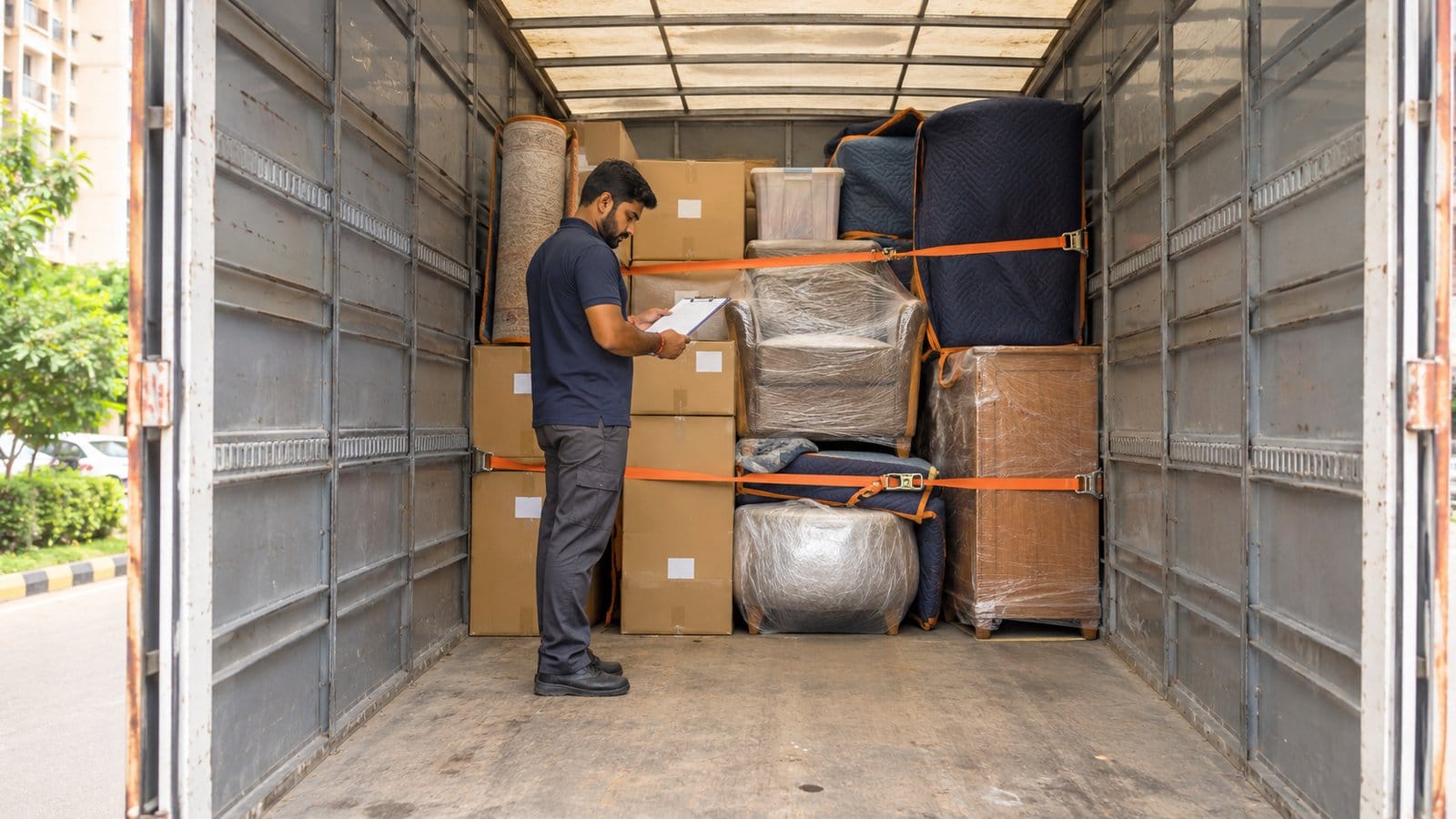
Transit insurance for a household move is a policy from an insurance company that pays for loss of or damage to your goods while they are being moved, from the causes the policy lists and up to the value you insure. It is separate from the mover's own liability, which the Carriage by Road Act, 2007 limits, so the two answer different questions when something arrives broken.
This guide starts with what the law makes a carrier responsible for, then reads one insurer's published policy wording clause by clause, so you know what to ask before the truck is loaded. For how the insurance line should appear on paper, see what a proper written moving quote should contain. If something has already been damaged, our guide to filing a damage claim after a move takes it from delivery day.
How is a mover's liability different from transit insurance?
They come from different places, have different limits and are claimed from different people.
| Question | The mover's liability | Transit insurance |
|---|---|---|
| Who pays | The mover, as carrier | The insurer named on the policy |
| Where the rules come from | The Carriage by Road Act, 2007, the Carriage by Road Rules, 2011 and your quote | The policy wording, filed with a unique number (UIN) |
| Upper limit | For total loss, ten times the freight, never above the value you declared, unless you agreed a higher risk rate | The sum insured you chose, less any excess |
| Who has to prove what | You need not prove negligence; the carrier escapes only by proving the loss was not its fault | Under named-peril cover, you show the loss came from a listed cause |
| Cost | No separate charge; a higher risk rate, if agreed, costs more | A separate premium |
The two can sit side by side. A move can have the carrier's statutory liability and an insurance policy, and the claim then runs on both tracks.
What does the Carriage by Road Act make a mover liable for?
The Act regulates "common carriers", which it defines broadly: a person in the business of collecting, storing, forwarding or distributing goods carried under a goods receipt, or carrying goods for hire by motor vehicle for anyone who asks. Whether a particular mover counts as a common carrier for a particular job is a legal question. The Act is still the place to start, because it is where the limits on liability are set. Here is what the Act as passed in 2007 says:
- You declare the value. Under section 8, the person sending the goods signs a goods forwarding note that includes a declaration of the value of the consignment, and is responsible for getting the particulars right.
- Liability is capped by rules. Section 10(1) limits the carrier's liability for loss or damage to an amount the rules prescribe, based on the value, the freight and the nature of the goods.
- You can buy wider liability from the carrier. Section 11 lets a carrier charge a higher risk rate for taking on more risk. To charge it, the carrier must display a printed or written notice of that rate, in English and in the State's language, at its business premises.
- You do not have to prove negligence. Section 12(2) says a person suing for loss, damage or non-delivery need not prove the carrier was negligent. Under section 10, the carrier avoids liability only if it proves the loss was not caused by its own fault or neglect, or that of its staff or agents.
- Some causes are excluded. Section 17 makes the carrier responsible for loss, damage or non-delivery from any cause except an act of God, war, riots and civil commotion, seizure under legal process, or a government order. Even then, it stays responsible if due care would have avoided the loss.
The cap itself is in rule 12 of the Carriage by Road Rules, 2011. For total loss, the carrier's liability is limited to ten times the freight paid or payable, and cannot exceed the value declared in the goods forwarding note. The freight figure used is the higher of the freight actually charged and 90 percent of the total charges on the goods receipt, leaving out taxes. As an illustration only, on a freight of ₹10,000 the cap for total loss would be ₹1,00,000, or the declared value if that is lower. Partial damage is assessed instead by a Government-approved valuer or surveyor, which the consignor chooses from the carrier's list; rule 12 puts the cost of that assessment on the carrier.
Two cautions. The rule also says the carrier is responsible only during the transit period, which ends three calendar days after the goods arrive. And the Act was amended by the Jan Vishwas (Amendment of Provisions) Act, 2026, with effect from 15 July 2026 under Ministry of Road Transport notification S.O. 3674(E). We quote the text as enacted, so check the current version on India Code before relying on a section.
What does a transit insurance policy cover?
It depends on the clause the policy is written on. For goods moved within India by road or rail, insurers use the Inland Transit Clauses. New India Assurance's customer information sheet describes ITC (A) as the wider, all-risk cover and ITC (B) as the restricted, named-peril cover.
The ITC-B wording that New India publishes covers physical loss or damage caused by:
- fire or explosion, and lightning;
- the breakage of bridges, an earthquake or volcanic eruption;
- a collision with or by the carrying vehicle, the vehicle overturning, or a derailment or similar accident.
Its product note adds that under named-peril cover the insured must show, on a balance of probabilities, that the loss came from one of those causes. A cracked table top with no accident on the road is hard to fit into that list. So the clause letter on the policy tells you more than the word "insured" printed on a quote.
Two more points from the same documents. The sheet says these policies are mostly written on an agreed-value basis, with the sum insured as the most the goods are worth in transit. And every claim is subject to an excess, the part of each loss you carry yourself; the sheet's example uses 1 percent of the consignment value with a minimum of ₹10,000, as an illustration rather than a fixed term. That wording is written for business cargo, so if you are offered inland transit cover for a house move, check that the schedule names household goods.
What does transit insurance usually exclude?
The exclusions in the ITC-B wording are typical of what to look for in any policy. The right-hand column is our reading of what each one means in a home move.
| Clause in New India's ITC-B wording | In a house move, this can mean |
|---|---|
| 2.2 Ordinary wear and tear | Old scratches, a worn sofa or a loose drawer that was like that before |
| 2.3 Insufficient or unsuitable packing by the insured or their employees | Cartons you packed yourself; the wording says "employees" does not include independent contractors |
| 2.4 Loss caused by delay | A late delivery is not, by itself, a loss under the policy |
| 2.5 Inherent vice or nature of the goods | Things that spoil on their own, such as food |
| 2.1 and 2.7 Wilful misconduct of the insured; deliberate damage by a wrongful act | Deliberate damage is outside named-peril cover; the information sheet says malicious acts are excluded only under B and C clauses |
| Clause 5 Strikes, riots, civil commotion, terrorism | Excluded unless the separate SRCC clause for transits within India is added |
Some things are best kept off the truck altogether. Jewellery, cash and important papers should travel with you; we do not carry jewellery or cash in any case. For appliances, preparation affects both the damage risk and the argument about packing: our guide to taking down and refitting ACs, TVs and other appliances explains who does what.
When does the cover start and stop?
Later and earlier than many people assume. Under clause 6 of the New India wording, cover starts when the goods are first moved for immediate loading onto the vehicle. It ends at whichever of these comes first:
- unloading at the final destination named in the policy;
- unloading into any other warehouse that you choose to use for storage outside the ordinary course of transit;
- for a road transit, seven days after the vehicle reaches the destination town.
Read with care, this means packing in your flat before loading begins is not part of the journey under that wording, and a gap between two flats breaks it. If your goods will wait in our warehousing between a move-out and a move-in, ask for storage cover separately; our post on short-term storage between two flats in Gurgaon covers the planning side.
How are the declared value and the premium set?
The declared value is your figure, and it caps the claim. Build it from a room-by-room list, with the larger and newer items named and valued one by one. A low figure limits what the policy can pay. If you give the same figure on the goods forwarding note, it caps the carrier's liability too, so under-declaring costs you twice.
The premium is the insurer's to set, on the sum insured and the cover chosen. We have not published a premium rate and will not guess one here. Ask for these five things in the written quote:
- To do: the premium as its own line, with the tax shown;
- To do: the sum insured it is based on;
- To do: the clause, A or B, and any added clause such as SRCC;
- To do: the insurer's name and how you will receive the policy or certificate number;
- To do: the excess on each claim.
If the mover arranges the policy, ask for the certificate before the move and check the number with the insurer. The wording also says the insurance does not benefit the carrier: it protects the owner of the goods, not the mover. It puts a duty on you as well, to keep your rights against the carrier alive by lodging a monetary claim with it within six months of the lorry receipt, or the period a statute sets. Keep the goods receipt safe for that reason.
What do Maxx Relocation's terms say about insurance?
Our terms and conditions do not fix one answer for every move. Your written quotation states three things: how far we answer for any loss or damage, whether the price includes transit insurance and on which terms, and how long you have to report damage. Where the quote has no insurance, raise it with us while you are booking, not on moving day.
When the goods arrive, the same terms ask you to tick them off against our numbered inventory and to note anything damaged or short on the delivery list, and only then sign it. For a quote that spells out the cover, the sum and the excess, tell us about the goods and both addresses through the quote form. For the rest of the service, see how our packers and movers in Gurgaon plan a home move.
This article is general information, not legal or insurance advice. Read your own policy wording, and check the current text of the Act on India Code.
Sources
- The Carriage by Road Act, 2007 (No. 41 of 2007), sections 2, 8, 10, 11, 12 and 17, as enacted
- Notification S.O. 3674(E): commencement of the Jan Vishwas (Amendment of Provisions) Act, 2026 for the Carriage by Road Act, 2007
- Carriage by Road Rules, 2011, rule 12 (Liability of common carrier)
- Inland Transit (Specific Voyage policy, ITC-B 2010), UIN IRDAN190RP0021V01100001
- Customer Information Sheet: Marine Cargo Specific Voyage Policy
- Terms and Conditions